
There's a pattern showing up in every serious "AI agent" conversation right now.
Founders, engineering leads, agency teams, all describe their agent the same way: "the model picks up an intent, calls a tool, replies in the channel the user is on, learns from the outcome."
Five sentences, very crisp. Done in a week.
Then you actually try to build one. And you discover that the model and the tool calls are 30% of the work.
The other 70% is plumbing nobody talks about. It isn't sexy and it doesn't fit on a slide.
This post is about that 70%.
The illusion of "just call the model"

The classic mental model for an AI customer agent looks like this: user says something, agent thinks, agent responds, customer is happy.
Three boxes, two arrows. That's the demo.
The actual production system has at least eight more boxes between "agent thinks" and "customer is happy."
Who is this contact, really?
Not just "the email that just hit the API." It's the canonical user record across web signup, support form, WhatsApp number, and the anonymous device id from before they signed up.
Without dedup, the agent talks to ghosts.
What channel are they on right now?
Web, email, WhatsApp, SMS, in-app. Each has a different delivery API, a different rate limit, a different rendering model, a different consent regime.
Picking the wrong one is worse than not replying at all.
What's already happened?
The agent's reply is conditional on history. Did we already send the welcome email? Has this user opened anything in the last 30 days? Did they explicitly opt out of marketing 6 months ago? Did the previous reply bounce?
History isn't optional context. It's the input that determines whether the agent says anything at all.
Did the message actually get there?
Email and WhatsApp can fail silently for a dozen reasons: spam, blocked number, expired session, throttling.
The agent needs to know if its action succeeded. Not just if the API call returned 200.
And then there's the boring stuff
Retries, idempotency, dedup. Audit logs. Compliance (GDPR, SPF/DKIM/DMARC, WhatsApp 24-hour rule). Observability that goes beyond "look at the logs."
None of these are interesting in a Loom video. All of them decide whether the agent works in production or crashes the second a real user hits it.
The split that nobody draws on the slide
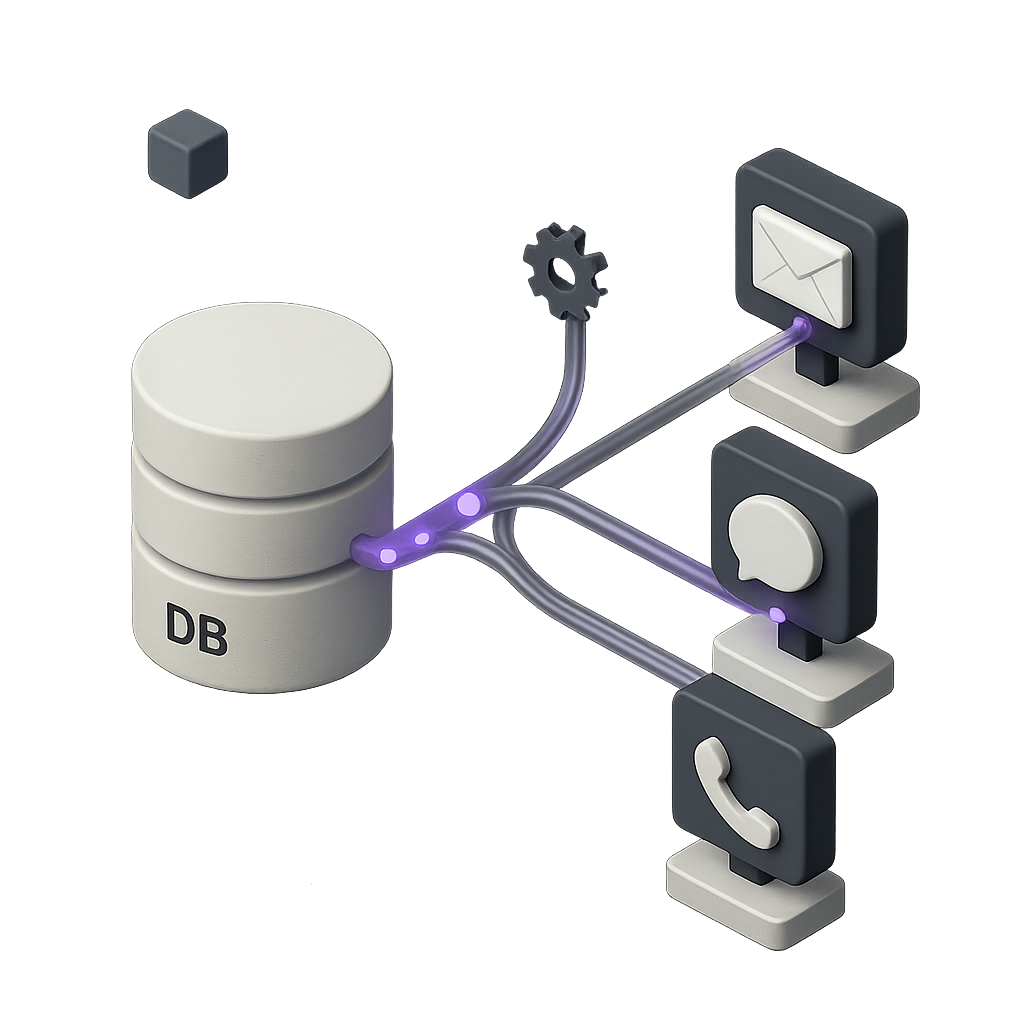
There are two layers under every customer-facing AI agent. Most teams pretend there's only one.
The intelligence layer
This is where the differentiation lives. The agent's policy. The prompt design. The tool orchestration. The evals. The memory. The handoff strategy. The way it decides when to escalate to a human.
This is where your team makes the product feel smart, on-brand, and uniquely yours.
This is where you should spend 100% of your engineering time.
The infrastructure layer
This is the messaging-native plumbing.
Contact state. Multichannel delivery. State machines. Audit logs. Retries. Compliance. Deliverability. Templates with variables. Segments. Goal tracking.
It's necessary. It's commodity. Two competing teams of three engineers will both produce the same boring system here, given enough time.
Building it is a tax, not an advantage.
What most teams do
They start with the intelligence layer because that's the fun part.
Then they bleed weeks rebuilding email infrastructure, WhatsApp queue handling, contact deduplication, and retry logic.
Three months in, the agent works, but only inside a narrow demo path. Any deviation breaks something downstream. The team is exhausted, the model still feels generic, and the deliverability is mediocre.
What works instead
Assume the infrastructure layer is bought, not built.
Pour every engineering hour into the intelligence layer. That's where the moat is.
What a messaging-native layer actually has to do
If you're going to buy this layer instead of build it, you need to know what to demand from it.
Anything missing from the list below is going to cost your team a week of plumbing later.
1. DB-native, not API-driven
The agent doesn't tell the messaging layer "send this email to user 47."
The agent updates the database (or the database is updated by the user's action), and the messaging layer reacts.
This inverts the integration. Instead of every agent action triggering an HTTP call you have to babysit, the agent just changes state, and lifecycle messaging happens because the data changed.
Real-time Postgres replication or change data capture is the underlying primitive. Without it, you'll wire webhooks for every event and the system becomes brittle in months.
2. Multichannel as a first-class concept
Email, WhatsApp, SMS, in-app, push.
The messaging layer should expose a single send_message(channel, intent, content) primitive and handle the delivery specifics underneath.
If it forces you to integrate three vendors and reconcile their delivery logs separately, you've already lost.
3. Stateful by design
Did the agent just send "welcome 1"? Then "welcome 2" should fire 24 hours later, only if the user hasn't reached the activation milestone yet.
That's not a separate cron service you run. It's the core abstraction of a workflow engine sitting under the messaging layer.
If your infra layer doesn't have a workflow engine with wait, branch, and goal_check nodes, you're going to write one.
4. Observable, with proper goal tracking
Your agent's actions should produce signals you can correlate with outcomes.
Did the personalized message increase activation by 12%, or did it tank it?
You need cohort analysis, breakdown by intent, comparison to a baseline. All without writing SQL every time you want to look.
If observability is "look at the logs," you're not iterating. You're guessing.
5. Agent-friendly access via API and MCP
The infra layer must be programmable from inside whatever environment your agent runs in.
If you can only manipulate it from a web dashboard, your agent can't actually use it autonomously.
Modern infrastructure should expose the full action surface as both a typed API and an MCP server. Agents discover and call tools without bespoke glue per integration.
6. Compliance and deliverability as a service
Sender authentication, opt-out enforcement, WhatsApp template approval, suppression lists, bounce handling.
None of this should be the agent team's problem.
If you have to set up DKIM yourself, your infra is too low-level.
Putting it together
A layer that does all six is not a "send email" service. It's the substrate that makes building agentic engagement actually feasible without a 6-month detour.
Case study: how Digital Kitchen runs
The clearest signal that this split works is when agencies and studios start treating it as standard practice.

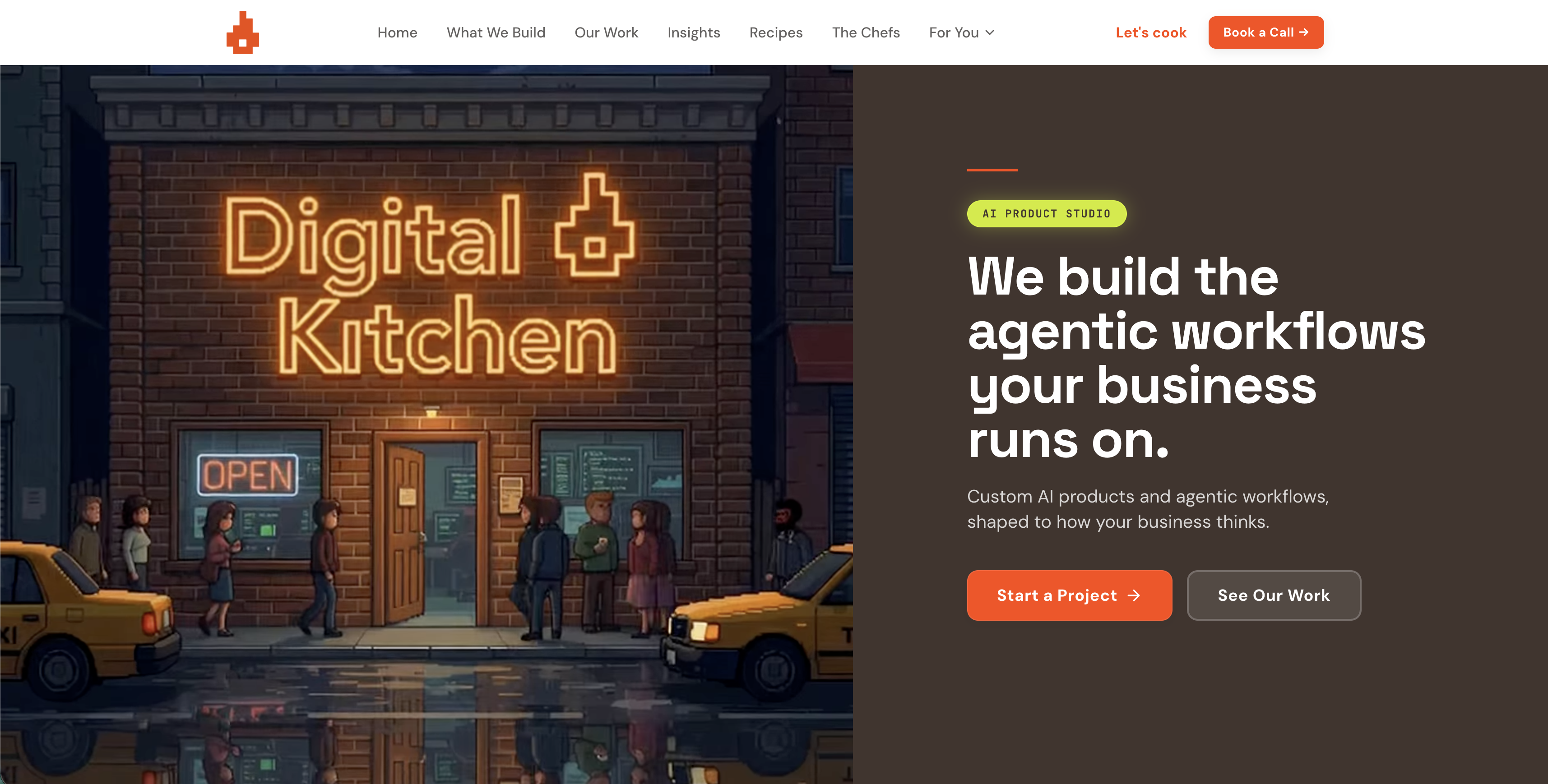
Digital Kitchen Studio is an AI product studio building agentic workflows for SMBs and agencies.
Their public-facing brand is the "kitchen" metaphor. Every project is a recipe, the team are chefs, and clients book "a call with the chef."
Look past the metaphor. The underlying engineering practice is straightforward: separate what's commodity from what's signature, and build only the signature.
The 70/30 rule, applied
Their pitch to clients is essentially:
"The boring 70% is already standardized on a platform like Minimo. Our chefs spend their time on the 30% that's actually intelligent and unique to your business."
A SaaS onboarding agent that would take 6 weeks from scratch becomes a 5-day engagement.
They're not rebuilding contact dedup, multichannel delivery, and goal tracking on every project. The plumbing is already there. They add the brain.
Why this is the future
The infrastructure layer is a commodity that gets cheaper and better over time as a category.
The differentiation moves up the stack, to the agent's policy and personality.
Trying to vertically integrate the whole stack in 2026 is the same mistake teams made building their own auth in 2018. Technically possible. Totally not where the value is.
Book a call with Digital Kitchen →
A checklist before you build
Before your team starts another sprint of "let's wire up email and WhatsApp ourselves," answer four questions honestly.
1. Visible or invisible?
Is the infra you're about to build going to be visible to a customer, or invisible?
If it's invisible (delivery, retries, dedup), you're building commodity.
2. Defensible?
Will a competitor with one fewer engineer ship a worse version of the same thing in three months?
If yes, the infra is undifferentiated.
3. Where does the calendar go?
Are you spending more than 30% of your agent project's calendar time on plumbing?
If yes, you bought the wrong split.
4. How fast to multichannel?
If your agent had to send a WhatsApp message tomorrow morning, how many days of work are between you and that being real?
If the answer is more than two, your infra layer is not multichannel-native.
The takeaway
AI agents are the obvious next layer of customer-facing software.
But the agent itself is a thin layer on top of a thick, boring, mission-critical messaging-and-state infrastructure. That infrastructure has nothing to do with intelligence.
It's now commoditized. Treating it as something you buy instead of build is the single biggest leverage move available to teams shipping agentic engagement in 2026.
Build the intelligence. Buy the messaging-native layer underneath. Ship the agent in days.
If you don't want to build the agentic layer yourself
Digital Kitchen Studio builds custom AI agents and agentic workflows for SMBs, agencies, and mid-market companies.
They operate on top of Minimo, so the messaging plumbing is solved before they start cooking.
If you're building the agent yourself
DB-native. Multichannel. MCP-ready. 1,000 emails per month on the Free plan, no credit card needed.